Loading...
Searching...
No Matches
docwire::xml::reader< safety_level > Class Template Reference
A forward-only, non-cached XML reader. More...
#include <xml_reader.h>
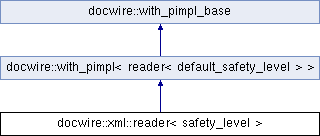
Inheritance diagram for docwire::xml::reader< safety_level >:
Public Member Functions | |
| reader (std::string_view xml_sv, reader_blanks blanks_option=reader_blanks::keep) | |
| Constructs a reader from a string view. | |
| bool | read_next () const |
| Advances the reader to the next node. | |
| std::string_view | content () const |
| Returns the content of the current node (e.g., text inside an element). | |
| std::string_view | name () const |
| Returns the local name of the current node. | |
| std::string_view | full_name () const |
| Returns the full name (including namespace) of the current node. | |
| std::string_view | string_value () const |
| Returns the string value of the current node (concatenated text of children). | |
| bool | move_to_first_attribute () const |
| Moves the reader to the first attribute of the current element. | |
| bool | move_to_next_attribute () const |
| Moves the reader to the next attribute. | |
| void | move_to_element () const noexcept(safety_level==relaxed) |
| Moves the reader back to the element containing the attributes. | |
| non_negative< int, safety_level > | depth () const |
| Returns the depth of the current node in the XML tree. | |
| node_type | type () const |
| Returns the type of the current node. | |
Additional Inherited Members | |
| Protected Types inherited from docwire::with_pimpl< reader< default_safety_level > > | |
| using | impl_type |
| Protected Member Functions inherited from docwire::with_pimpl< reader< default_safety_level > > | |
| impl_type * | create_impl (Args &&... args) |
| with_pimpl (Args &&... args) | |
| with_pimpl & | operator= (with_pimpl &&other) noexcept |
| impl_type & | impl () |
Detailed Description
template<safety_policy safety_level = default_safety_level>
class docwire::xml::reader< safety_level >
class docwire::xml::reader< safety_level >
A forward-only, non-cached XML reader.
This class provides a wrapper around libxml2's xmlTextReader, offering a modern C++ interface with configurable safety policies.
- Template Parameters
-
safety_level The safety policy to use (strict or relaxed).
- Warning
- This is a single-pass reader. Once the reader advances, previous nodes cannot be revisited.
- See also
- XML parsing example
- Examples
- xml_parsing_example.cpp.
Definition at line 63 of file xml_reader.h.
Constructor & Destructor Documentation
◆ reader()
template<safety_policy safety_level = default_safety_level>
|
explicit |
Constructs a reader from a string view.
- Parameters
-
xml_sv The XML content to parse. blanks_option Specifies whether to keep or ignore blank nodes (default: keep).
Member Function Documentation
◆ move_to_element()
template<safety_policy safety_level = default_safety_level>
|
noexcept |
Moves the reader back to the element containing the attributes.
- Exceptions
-
docwire::error In strict mode, throws if the operation fails (e.g., reader is not positioned on an attribute).
◆ move_to_first_attribute()
template<safety_policy safety_level = default_safety_level>
| bool docwire::xml::reader< safety_level >::move_to_first_attribute | ( | ) | const |
Moves the reader to the first attribute of the current element.
- Returns
- true if successful, false if no attributes exist.
◆ move_to_next_attribute()
template<safety_policy safety_level = default_safety_level>
| bool docwire::xml::reader< safety_level >::move_to_next_attribute | ( | ) | const |
Moves the reader to the next attribute.
- Returns
- true if successful, false if no more attributes exist.
◆ read_next()
template<safety_policy safety_level = default_safety_level>
| bool docwire::xml::reader< safety_level >::read_next | ( | ) | const |
Advances the reader to the next node.
- Returns
- true if a node was read, false if the end of the document was reached.
The documentation for this class was generated from the following file:
